

Trexo Robotics represents a breakthrough in how children with mobility limitations can experience movement. Through cutting-edge robotic gait support, Trexo enables children to stand tall, take steps, and explore their world with confidence. Proudly brought to Australia by APEX Mobility, this technology is redefining possibilities in paediatric mobility and rehabilitation.
The Trexo Robotics Mobility Device attaches to the trusted Rifton Pacer to enable safe, repeatable, and engaging overground walking for children across a wide range of abilities.
_1763085541.png)
Intuitive Tablet Control
Trexo’s intelligent tablet interface elevates the user experience by combining powerful data insights with effortless control. The sleek, modern design allows users to fine-tune gait patterns and instantly view real-time performance data, giving both clinicians and families the ability to deliver highly personalised and responsive robotic-assisted mobility sessions.
_1763079331.png)
_1763066308.png)
Scale Your Clinic’s Impact with Intelligent, Data-Driven Gait Training
Trexo Plus is purpose-built for clinical environments, giving therapy teams the tools to deliver safe, repeatable, and highly personalised robotic-assisted walking sessions. With the ability to support multiple child profiles, clinicians can easily tailor and store individualised therapy plans - making Trexo Plus ideal for multidisciplinary teams, busy clinics, and high-demand paediatric caseloads.
Designed for therapist-supervised overground walking, Trexo Plus encourages natural movement patterns while enabling clinicians to maintain full oversight and control. Its intelligent tablet interface delivers real-time gait analysis, helping therapists track performance, monitor improvements, and make informed decisions that support better outcomes.
By promoting improved gait symmetry, endurance, and engagement, Trexo Plus enhances the effectiveness of each session and helps children experience meaningful progress. With seamless integration into existing rehabilitation programs and clinical workflows, Trexo Plus allows therapy teams to elevate their services without disruption - bringing the future of paediatric gait training directly into the clinic.
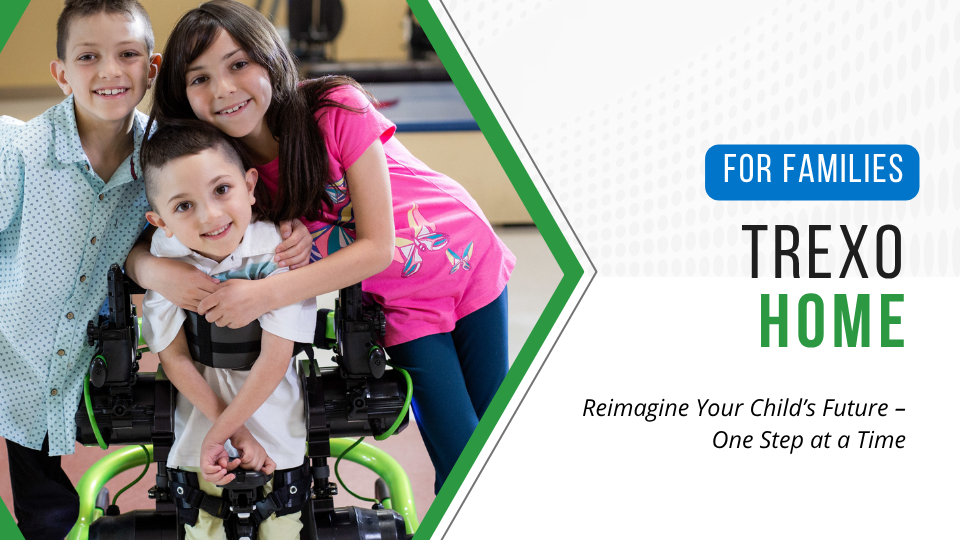
Reimagine Your Child’s Future - One Step at a Time
Trexo Home brings the power of robotic-assisted walking directly into your home, giving children the opportunity to practise movement every day in a safe, familiar environment. With personalised gait settings, real-time progress tracking, and an intuitive tablet interface, families can support their child’s mobility journey with confidence and consistency.
Each session helps build strength, endurance, alignment, and engagement - turning everyday moments into meaningful steps forward. Trexo Home empowers families to create new routines, celebrate new milestones, and reimagine what’s possible for their child’s future.
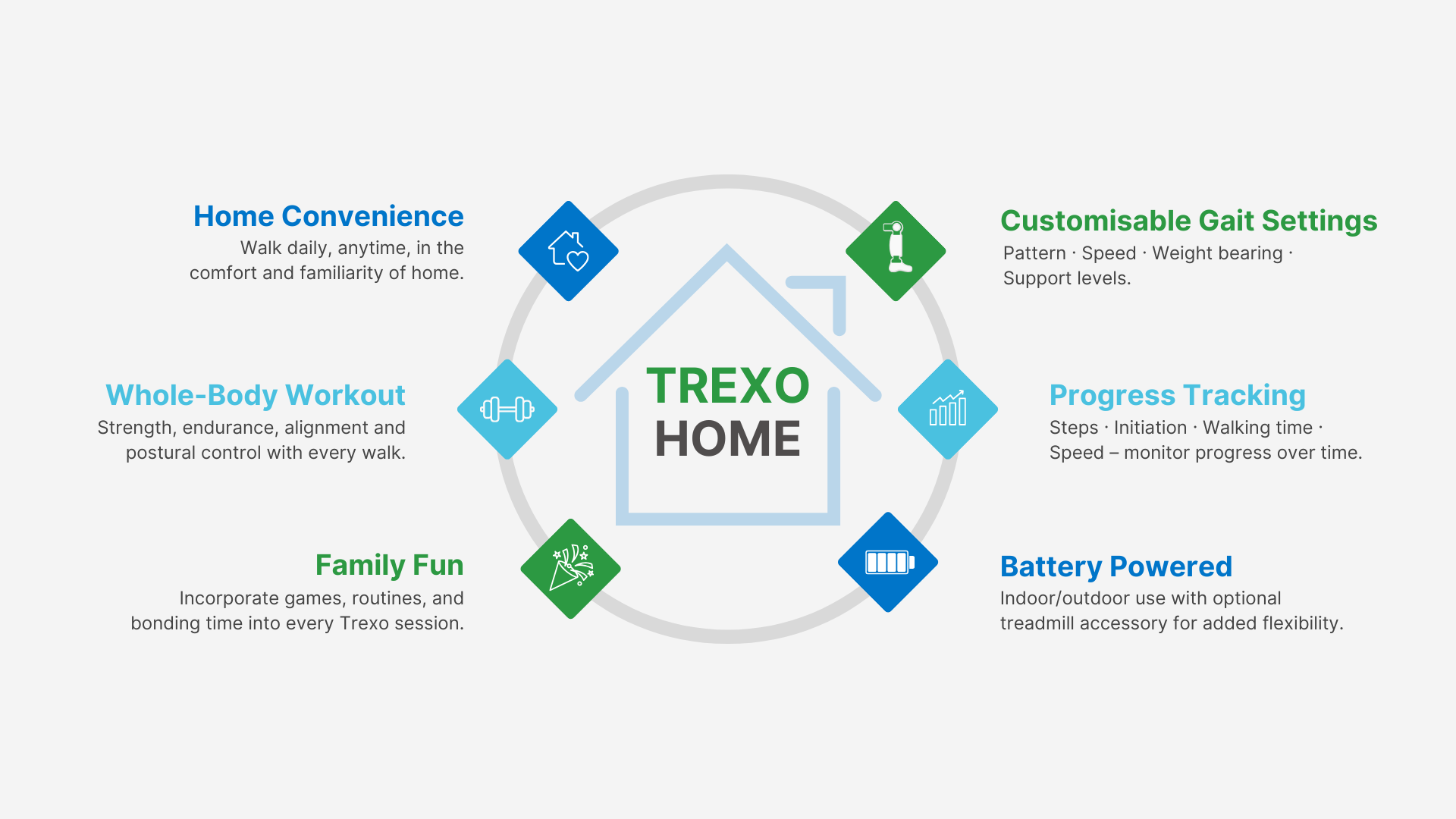
Supporting Every Step – Tailored to Each Child’s Ability
Trexo’s adaptive support system is designed to meet every child exactly where they are in their mobility journey - encouraging active participation while maintaining safe, consistent gait patterns. As children walk, the device provides real-time visual feedback through intuitive coloured lights on the joints, helping families and clinicians understand how the child and the robot are working together:
Blue – Child is Initiating
The child is actively starting the movement, demonstrating effort and independent motor activation.
Pink – Child is Resisting
Indicates when a child is finding the movement challenging or pushing back, offering valuable insight to guide adjustments or support.
Purple – Device is Guiding Motion
Trexo is providing smooth, structured assistance to help the child complete each step safely and consistently.
This intelligent feedback complements Trexo’s highly customisable programming, allowing clinicians to adjust parameters such as step length, speed, joint angles, and weight bearing to optimise therapeutic outcomes. As children grow stronger and more confident, Trexo gradually shifts more control to them - promoting independence, improving engagement, and supporting meaningful progression over time. Suitable for a wide range of abilities, Trexo ensures every step is personalised, purposeful, and grounded in evidence-based gait support.
_1763079382.png)
Conditions Trexo Can Support
- Cerebral Palsy (GMFCS III–V)
- Brain Injury
- Neuromuscular Conditions
- Spinal Muscular Atrophy
- Muscular Dystrophy
- Stroke
- Hemi/Paraplegia
- Spinal Cord Injury
- Rett Syndrome and more.
Proven Outcomes. Clinically Backed.
Understanding the evidence behind paediatric mobility interventions is essential when evaluating emerging technologies like Trexo Robotics.
The State of the Evidence Traffic Lights 2019: Systematic Review of Interventions for Preventing and Treating Children with Cerebral Palsy provides one of the most comprehensive evaluations of therapies used to support children with cerebral palsy.
When we look at the circled items in the graph below, we can clearly see that several interventions central to Trexo’s design - mobility training, treadmill training, partial body-weight supported gait training, task-specific training, and goal-directed training - are all classified as Effective within the Evidence Alert Traffic Light System. Even mobility training for children in GMFCS IV–V, which aligns closely with Trexo’s target population, is rated as Probably Do It, placing it above the “Worth It” line.
These findings demonstrate that the core therapeutic principles underpinning Trexo are not only well established but also strongly supported by high-quality evidence, reinforcing Trexo’s role as a clinically meaningful tool in paediatric gait rehabilitation.
_1763955812.png)
Robot-Assisted Gait Training with Trexo Home (Diot et al.)
Robot-assisted gait training is emerging as a valuable tool in supporting children with significant mobility impairments, offering a new avenue for improving both physical function and secondary health outcomes. A prospective observational study by Diot et al. explored how families are using the Trexo Home robotic gait trainer in real-world settings and what early benefits are seen after the first month of use. By examining who is using Trexo, how often they train, and what changes occur during the initial adoption period, this study provides meaningful insight into the practical, day-to-day impact of home-based robotic gait training.
Study Summary
The Diot et al. study followed 70 participants (median age 7, range 2–24), the majority of whom had cerebral palsy (83%) and did not walk for mobility (95%). Using parent-reported questionnaires collected before and after one month of training, the research found that families were able to integrate Trexo Home into regular routines, achieving 2–5 training sessions per week in both home and community environments.
After the first month of use, families reported a significant improvement in sleep quality (p = 0.0066), suggesting that regular upright movement and robotic-assisted walking may positively influence rest and nighttime comfort. Although changes in bowel function, positive affect, and overall physical activity were not statistically significant, many families observed reduced constipation and increased time spent upright and mobile.
These findings demonstrate that children with severe mobility impairments can successfully engage in frequent robotic gait training at home - and that early, measurable benefits, particularly in sleep, may emerge within weeks. The authors note that Trexo Home shows strong potential as a multi-modal intervention and recommend further research with longer training periods to better understand the relationship between usage volume and therapeutic outcomes.
Dynamic Standing Exercise Study (Lauruschkus et al., 2022)
Dynamic standing and activity-based robotic exercise are increasingly recognised as powerful tools for improving comfort, wellbeing, and participation in children with cerebral palsy who are non-ambulant. While traditional static standing frames are widely used in standard care, families and clinicians often face challenges with time, cost, and limited engagement. The Lauruschkus et al. (2022) study provides valuable insight into the benefits of dynamic standing compared with static standing, showing that movement-based interventions - including robotic gait technologies - can improve quality of life, reduce fatigue and discomfort, and enhance focus and participation in meaningful activities.
Study Summary
This randomised controlled cross-over study involved 20 children with cerebral palsy who were non-ambulant (mean age 11.6 years). Each child participated in four months of static standing and four months of dynamic standing using a motorised device designed to facilitate assisted walking-like movement. Quality of life was measured using the CPCHILD, a validated and reliable tool tailored to children with severe cerebral palsy, alongside additional study-specific questionnaires examining daily life and cost-effectiveness.
Across the cohort, dynamic standing demonstrated clear advantages:
- Improved quality of life, including better comfort, wellbeing, and daily participation
- Reduced fatigue and discomfort, with families reporting their children appeared more alert and engaged
- Enhanced focus and attention, supporting participation in everyday activities
The study concludes that dynamic standing provides important advantages over traditional static standing and may inform more personalised, movement-focused standing recommendations for children with severe mobility limitations. These findings reinforce the growing evidence that movement-based, dynamic interventions - such as robotic gait training - can offer significant, multi-dimensional benefits to children who are non-ambulant, supporting a more active, comfortable, and engaged daily life.
The Heart Behind the Innovation
_1762925042.png)
Walk Into the Future with Trexo
_1762926765.png)
Trexo is redefining paediatric mobility by combining robotics, rehabilitation best practice, and child-centred design.
For clinics, Trexo Plus empowers therapists to deliver more movement with less physical strain, maximising every session’s outcomes.
For families, Trexo Home offers daily opportunities for progress, freedom, and participation – right from home.
For more information or support on the Trexo Robotic Mobility Device and to be put in contact with one of our distributors around Australia, contact the team at APEX Mobility on 1300 212 192.


